
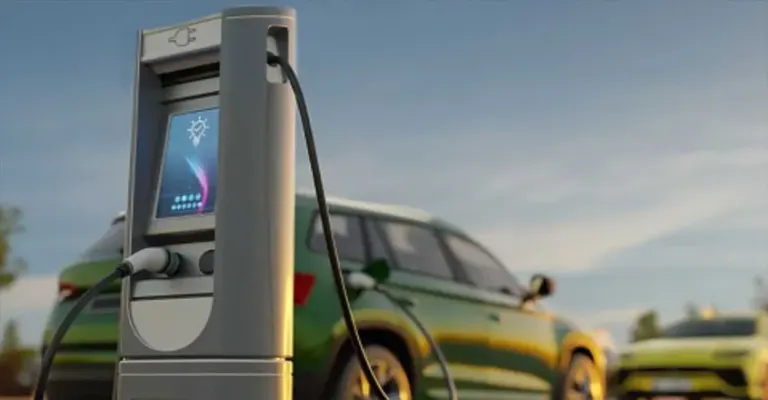
By implementing a payment security mechanism, the government will also promote the increased use of electric buses in the public transportation system.On Thursday, the government declared that it will support infrastructure for manufacturing and charging electric vehicles (EVs) in order to strengthen and grow the nation’s EV ecosystem.
Through a payment security mechanism, the government will also promote the increased use of electric buses in public transportation networks.
In India, EV sales increased significantly in 2023 compared to 2022. The Federation of Automobile Dealers Associations (FADA), an industry association, released data showing that the retail sales of electric vehicles increased by 114.71% for passenger cars, 114.16% for commercial vehicles, 65.23% for three-wheelers, and 36.09% for two-wheelers.
The government has already implemented Production Linked Incentive (PLI) programmes for the automotive and auto component industries, as well as advanced chemistry cell (ACC) battery storage, in an effort to strengthen the nation’s EV ecosystem. To encourage the use of EVs, there is also the Faster Adoption and Manufacturing of Electric Vehicles (FAME) programme.
Faster Adoption and Manufacturing of Electric Vehicles (FAME)
Over a five-year period, the PLI scheme for the automotive and auto component industries will cost a total of Rs 25,938 crore. In order to encourage investments in the automotive manufacturing value chain and to increase domestic production of advanced automotive technology (AAT) products, financial incentives are proposed. 18 businesses have been approved under the “Champion OEM” category and 67 under the “Component Champion” category as part of the scheme. Although it is anticipated that the scheme will result in total investments of Rs 67,690 crore, up to Q2 FY24, investments totaling Rs 11,958 crore have already been reported.
The PLI scheme for ACC battery storage, which will cost a total of Rs 18,100 crore over seven years, aims to attract major domestic and foreign players in this market and improve India’s manufacturing and export capacities. The programme agreement to implement the PLI ACC programme for the establishment of manufacturing facilities with a 30GWh ACC capacity has been signed by three of the approved firms under the scheme. Rebidding for the remaining 20GWh is currently underway, despite the implementing firms’ estimated total investment of nearly Rs 14,810 crore for the 30GWh capacity.
The government has offered subsidies totaling Rs 5,228 crore as of December 1, 2023, to encourage the sale of 11,53,079 EVs under the second phase of the FAME scheme.In order to support the electrification of public and shared transport, the FAME II scheme, which had an outlay of Rs 10,000 crore over five years, started on April 1, 2019, and provided subsidies for 7,000 electric buses, 5,000,00,000 electric three-wheelers, 55,000 electric cars and 10,000,000 electric two-wheelers. Under the FAME II programme, infrastructure development for charging is also encouraged.
“Our government will support manufacturing and charging infrastructure to expand and strengthen the electric vehicle ecosystem,” Finance Minister Nirmala Sitharaman declared during the Interim Budget 2024 presentation.

